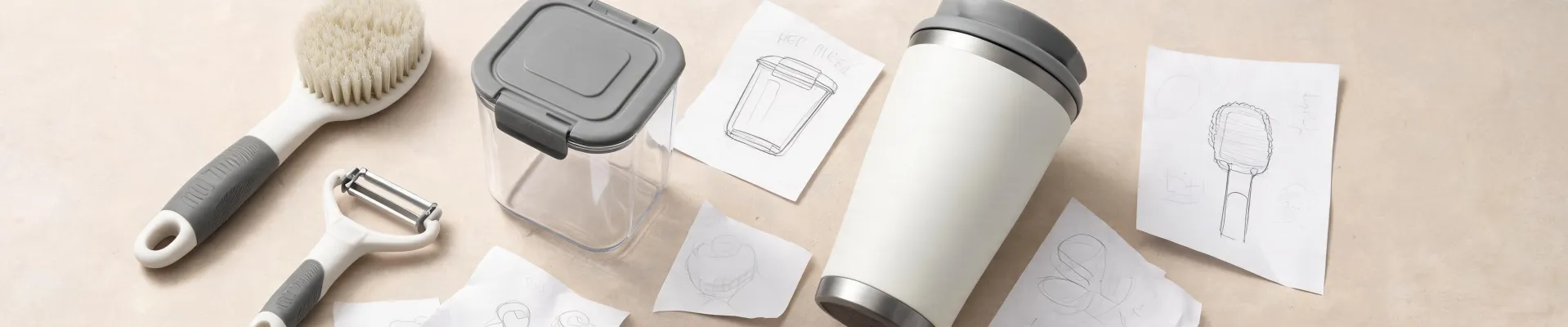
A peeler that skips costs more than a minute. The reflex is to lean on it, and the harder you push the deeper the edge bites, so a two-pound bag of russets comes down to nubs and the trim bowl ends up fuller than the pan. A handle that goes slick by the third wet potato turns the same tool into an unguarded blade, and a paring knife tip dug under a sprout craters the tuber you were trying to rescue.
None of that comes down to technique. What fails is one fixed blade on a smooth handle: a single edge has to plane a curved potato flat, and a polished handle has nothing to grab once starch and wash water coat your palm. The two Japanese stainless steel blades on the OXO Good Grips Y peeler flex so one stroke lies along the curve and covers a wider band of skin, the soft grip holds when it is wet, and the built-in eyer rides at the end of the handle as a rescue tool for a blemished potato, not a speed tool.
Why the peel skips and gouges on waxy skins
A Y peeler head with two blades spans a wider arc than a single straight blade, and the flex in those blades lets them follow the bulge of a potato instead of shaving it flat. That geometry is why one stroke takes a broad ribbon of skin rather than a thin strip, and why the same head that works on a round russet also handles a long carrot without you re-angling your wrist every few inches.
Peel depth is set by the gap between the blade and the head, roughly 1 to 2 mm on a peeler of this class, not by how hard you push. When the peel skips on a waxy new potato or a cucumber, the reflex is to press harder, and that is the mistake: the extra load closes the gap against the skin and the edge digs into flesh. If the skin is thin and waxy, go with light pressure and long strokes and let the blades do the cutting. If it is thick and knobby, like a russet, the trade-off is more strokes against more waste, and you accept a slightly thicker peel rather than leaning on the head. Skip the downward pressure entirely; it buys you nothing but gouged potatoes.
Check grip first, then blade bite, then wear
Order matters here, because most peelers get replaced for the wrong reason. Start with the grip, not the blade: peel one potato with a deliberately dry hand, then one with a wet hand. If it only skips when your palm is wet, the fix is the grip and you can leave the blade alone.
Next, test the bite. Drag the head across a carrot or a potato and watch exactly where the stroke breaks. Skipping at the entry point is an angle signal, meaning you are starting too steep. Skipping mid-stroke points at the head itself, the flex of the blades or a bend at the rivet.
Then look for wear. Hold the head up to a light: a continuous bright line along both edges means sharp, a broken or glinting line means nicked or rolled. Rust tracking at the rivet is the third wear sign, and it shows up on peelers that sit wet in a dish rack far more than on ones that get dried.
Only after those three checks do you decide on a replacement. Five minutes of ordered checking against a second peeler you did not need is the trade-off, and the checks are cheap. A worn head that still bites after a grip fix is a different problem from a head that never bit in the first place.
Where the grip fails at the third wet potato
A handle rarely slips on the first potato; it slips on the third. Potato starch and wash water build a film on your palm as you work, and a hard, smooth handle then rotates inside your fist. The blade is still sharp. The grip is gone.
The soft compound on this handle and its cross-section keep contact through that film, and the shape is symmetrical, so a left-hander loads it the same way a right-hander does. If you peel left-handed and your current peeler has a molded right-hand contour, go with a symmetric handle. If you peel two potatoes a week, skip the wet-grip premium; it earns its keep only in long, wet batches.
The trade-off to name: a cushioned soft grip buys comfort across a full pot of potatoes, but it gives back less tactile feedback through the handle than a hard one, so you feel less of what the blade is doing at the tip. For anyone peeling by feel in dim light, that matters.
The eyer is a rescue tool, not a speed tool
The eyer sits at the end of the handle for one job: lifting a sprout or an eye in a single scoop instead of letting a knife tip crater the tuber. It carves out a blemish without tearing up the flesh around it, which is the difference between a potato that goes in the pot whole and one with a crater the water fills.
The rules are simple. If the blemish is shallow, skim it with the eyer tip and move on. If it is a deep rot or a green patch running into the flesh, skip the eyer and cut the whole section away; the trade-off is losing a chunk of potato against leaving solanine or rot in the pan.
Blemish work happens mid-batch, so leverage on the eyer depends on the same non-slip grip that keeps the peeler from rotating in your hand. A wet handle makes the eyer as unreliable as the blade, which is why the eyer only pays off on a tool whose grip you have already sorted out.
When a blade is worn or defective
The twin-blade head on a Y peeler of this type is a fixed assembly, not a user-swappable blade, so repair is rarely on the table. The real fork is wear against defect, and the two send you in opposite directions.
Wear shows up as a consistently nicked or rolled edge after long use, a head that has lost its bite no matter how you hold it, and rust tracking along the edge. If it is wear, go with a replacement, but only after the grip and technique checks came back clean; otherwise you are paying for the same mistake twice.
Defect looks different: a blade head that wobbles at the rivet, a handle that cracks at the collar where it meets the head, or two blades that splay apart unevenly instead of flexing as a pair. If you see a wobbling head or a cracked collar, skip the second purchase, keep the receipt, and file a claim through the brand's guarantee page. Chasing a warranty costs you time, and the trade-off is worth it, because it keeps you from paying twice for a manufacturing fault.
If you peel one potato a month and your current straight peeler still bites, this one is not for you; wet-grip comfort, thin flexing-blade peels and the eyer only pay off in fast, repeated, wet-handed peeling. For anyone working through a bag of potatoes or a tray of carrots, match the symptom to its cause, and buy a replacement only when the failure is wear and not the way you hold the tool.